Thursdays at Villa Kujoyama: the program for March 5, 2026
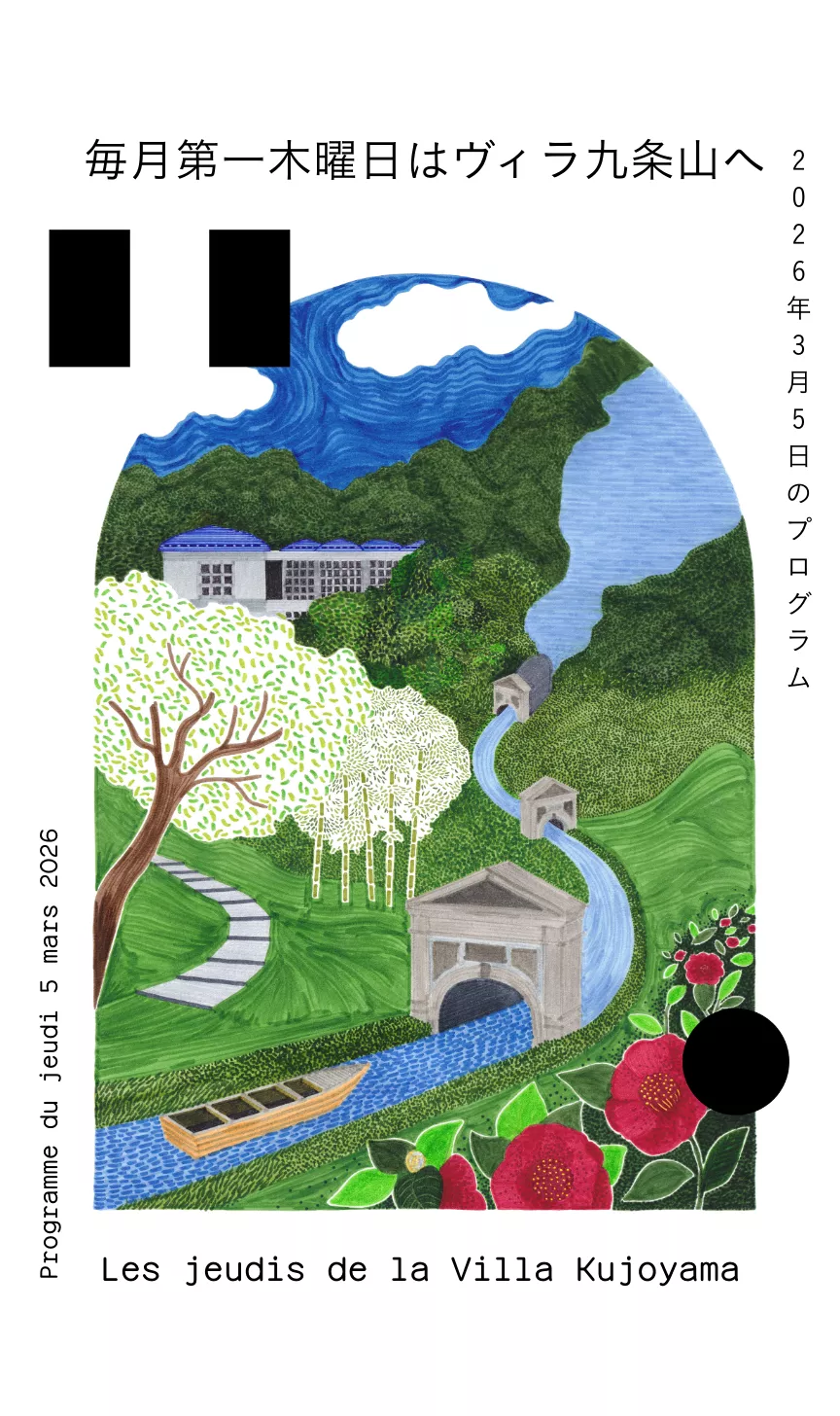
Dates
05 mar. 2026
14h00 - 21h00
Venue and informations
Villa Kujoyama
17-22 Hinookaebisudanichō, Yamashina Ward, Kyoto, 607-8492
Free entrance
Program
Program subject to change.
Schedule will be updated on this page.
Please note that Villa Kujoyama has no parking facilities for cars, only bicycle parking.
2:00 PM – 6:00 PM – Studios
Opening of the studios by Aurélie Lanoiselée, Isabelle Daëron, Diane Dufour, Victoire Thierrée, Claire Lange & Lucie Roy
2:00 PM – 6:00 PM – Salon
Presentation of research by Sandrine Elberg
Installation “Sur le chemin des escargots – On the Snails’ Path” by Simon Nicaise
4:30 PM – 6:00 PM – Auditorium
Sake Undeground: Discussion between Simon Nicaise and Kentaro Chokeiji (FR-JP)
6:30 PM – 8:00 PM – Auditorium
Conversation between artist Tomoko Sawada and curator Marina Amada (ENG)
8:00 PM – 9:00 PM – Salon
DJ set by DJ Sundae & Cocktail reception
TORO café will be selling snacks from 3 pm to 7 pm !
The residents's projets
An art of dining for a menu shaped by the passing of time — capturing the essence of the season in the present moment
Claire Lange and Lucie Roy are interested in the subtle links between the seasons in Japanese culture, particularly in the culinary arts, where each piece of tableware enters into a poetic dialogue with the time of year and the dish being served. Every two weeks, they will meet with a chef to explore the unique relationship he maintains with the present moment of the season. They will design the associated items of tableware, while also meeting with producers and foragers to draw local plants and study the seasonal representation of nature in the applied arts (Kyo-yaki porcelain, lacquerware, textiles).
Victoire Thierrée (2026, visual arts)
Into the Fog
Victoire Thierrée examines how, in 1944-45, the Imperial Japanese Army used washi paper to build balloon bombs that were launched against the United States, 10, 000 kilometers away. She wishes to work with a National Living Treasure in papermaking, and produce sculptures that investigate washi paper’s aerial properties, in connection with her research on E.A.T. (Experiments in Art & Technology).
Isabelle Daëron (2026, design)
Chikasui
After the project “Water Calling” in collaboration with Yoshiko Nagai, which maps Kyoto’s groundwater in texts and drawings, Isabelle Daëron’s wishes to examine interfaces with invisible water, which can be the water supply system or underground water, for example grids, valves, gullies and wells. Her objective is to extend this research to cities beyond Kyoto and, ultimately, propose objects for public spaces. The residency could conclude with an urban walking tour. The “world beneath our feet” has less symbolic resonance in Japan than in the west, and this is something Isabelle Daëron wishes to explore.
Diane Dufour (2026, exhibit curation)
FALLEN FROM GRACE – Desire and transgression in Japan’s post-war illustrated press
Japanese photography is celebrated worldwide yet the broader public is unfamiliar with one of its fundamental aspects: the printed page and, specifically, high-circulation illustrated press: a major platform for experimental visual creation in the post-war years. The intimate body, the political body, the marginal body: Diane Dufour’s research will focus on all these manifestations of desire, violence and transgression, guided by multiple interrogations: what do these images really express? What processes and authorities enabled their diffusion? What controversies did they spark? In collaboration with Ivan Vartanian, a Japanese-speaking curator in Tokyo.
Aurélie Lanoiselée (2026, crafts)
Perpetuate the Ephemeral
The project originated when Aurélie Lanoiselée met Yoshika Yajima, a doctoral candidate in Osaka whose thesis is on the tradition of hanamusubi (flower knots) during the Edo period from a gender perspective. Hanamusubi function as a codex, passed on only by women and only by hand. Aurélie Lanoiselée’s project questions the practice of a knot that is made to be untied and retied. Underlying themes will be how to make the invisible visible, ties within the social fabric, the encounter of cord and hand, a thought and a form-creating gesture.
Simon Nicaise (2024, visual arts)
Simon Nicaise continues his collaboration with the brewer-coopers of the Kioke Craft Revival on the island of Shodoshima, focusing on fermentation processes and their vessels. This friendship has extended through the creation of a sculpture immersed in a kioke containing soy sauce, where it rested for two years. A set of clay sake ware was also fired in Suzu in a kiln on a bed of rice straw, after drying for two years. As they were brought together, the pieces became the subject of an evolving presentation at each stage, in different contexts. At the Villa Kujoyama, they are exhibited alongside other works created along the way.
Sandrine Elberg (2021, photography)
Sandrine Elberg continues her artistic research on stones in gardens that contribute to Zen philosophy. In parallel with her work on faience, she will visit the Raku Museum, dedicated to the history and practices of clay firing, as well as the Yuzo Kondo Memorial Museum, in order to deepen her technical and conceptual knowledge.
Conversation between artist Tomoko Sawada and curator Marina Amada (ENG)
Photographer Tomoko Sawada and curator Marina Amada both live in the Kansai region but met in Paris in 2025 during a research residency organized by Maison Kochimi, a partner of Villa Kujoyama.
Tomoko Sawada has consistently employed typology and self-portraiture to develop conceptually constructed bodies of work presented both in Japan and internationally, exploring how identity is shaped through gaze and social frameworks.
Marina Amada engages in curatorial practice that connects the field of art with social discourse through the lens of gender, working on cultural initiatives such as AWARE (Archives of Women Artists, Research and Exhibitions) and SPECTRUM. Building on the mutual dialogue cultivated during their shared residency in Paris in 2025, they will share their evolving practices and thoughts.
Crédits
Visuel: Le lac Biwa, la Villa et les camélias
© Isabelle Daëron (2026, design)