Thursdays at Villa Kujoyama: the program for May 7, 2026
Thursdays at Villa Kujoyama
07 may. 2026Villa Kujoyama
Dates
07 may. 2026
14h00 - 21h00
Venue and informations
Villa Kujoyama
17-22 Hinookaebisudanichō, Yamashina Ward, Kyoto, 607-8492
Free entrance
Program
Program is subject to change. This page will be updated accordingly.
Please note that there is no parking space for cars in front of Villa Kujoyama (bicycle parking space only).
14:00–18:00 – Studios
Open studios by Aurélie Lanoiselée, Isabelle Daëron, Karl Mazlo, Raphaël Zarka, and Hippolyte Hengten
15:00–16:00 – Auditorium
“Washi – Beyond Paper”: conference by Emilie Even – Hariko Paper, specialist in Japanese washi paper (ENG)
17:00–18:15 – Auditorium
“Okinawa!! The Origins and Making of Victoire Thierrée’s Project”: conference by Victoire Thierrée with Yasuko Tomatsu, director of the INTERFACE Shomei Tomatsu Laboratory, moderated by Diane Dufour (FR–JP).
The exhibition Okinawa!! is presented at the Institut français du Kansai from April 17 to May 17, 2026, as part of the KG+ Festival. Victoire Thierrée received the KG+ 2026 Discovery Award for this project.
The discussion will also explore the influence of Shomei Tomatsu, a key figure in the history of Japanese photography.
18:30–20:00 – Auditorium
“Exploring Groundwater: Networks and Infiltration”: conference by Isabelle Daëron, Yuko Nagashima and Takashi Matsumura (Nagashima Foundry), and Hitomi Koga (Kumamoto Groundwater Foundation) (FR–JP)
20:00–21:00 – Salon / Terrace
Cocktail reception
TORO café will be selling snacks from 3 pm to 7 pm !
Les projets des lauréats
Chikasui
After the project “Water Calling” in collaboration with Yoshiko Nagai, which maps Kyoto’s groundwater in texts and drawings, Isabelle Daëron’s wishes to examine interfaces with invisible water, which can be the water supply system or underground water, for example grids, valves, gullies and wells. Her objective is to extend this research to cities beyond Kyoto and, ultimately, propose objects for public spaces. The residency could conclude with an urban walking tour. The “world beneath our feet” has less symbolic resonance in Japan than in the west, and this is something Isabelle Daëron wishes to explore.
Aurélie Lanoiselée (2026, crafts)
Perpetuate the Ephemeral
The project originated when Aurélie Lanoiselée met Yoshika Yajima, a doctoral candidate in Osaka whose thesis is on the tradition of hanamusubi (flower knots) during the Edo period from a gender perspective. Hanamusubi, shufuku and shutara function as a codex, passed on only by hand. Aurélie Lanoiselée’s project questions the practice of a knot that is made to be untied and retied. Underlying themes will be how to make the invisible visible, ties within the social fabric, the encounter of cord and hand, a thought and a form-creating gesture, all explored through exclusively Japanese materials.
Diane Dufour (2026, exhibit curation)
Desire and transgression in Japan’s post-war illustrated press
Japanese photography is celebrated worldwide yet the broader public is unfamiliar with one of its fundamental aspects: the printed page and, specifically, high-circulation illustrated press: a major platform for experimental visual creation in the post-war years. The intimate body, the political body, the marginal body: Diane Dufour’s research will focus on all these manifestations of desire, violence and transgression, guided by multiple interrogations: what do these images really express? What processes and authorities enabled their diffusion? What controversies did they spark? In collaboration with Ivan Vartanian, a Japanese-speaking curator in Tokyo.
Victoire Thierrée (2026, visual arts)
Into the Fog
During the second half of her residency, Victoire Thierrée will create a film that builds on her research into Experiments in Art and Technology (E.A.T.), drawing on original archival materials she consulted at the Getty Research Institute. The film will focus on the work of Japanese artist Fujiko Nakaya and address relationships between artificial and natural, visible and invisible: central elements of Nakaya’s work and contemporary society.
Raphaël Zarka (2026, visual arts)
Parallel Perspectives: Masakazu Horiuti and the uses of geometry in Japanese art
Raphaël Zarka intends to use his residency to familiarise himself with the work of Japanese modernist artist Masakazu Horiuti and conduct research into the use of geometry in Japanese art, prior to a joint exhibition with Horiuti which the KYOCERA Museum of Art in Kyoto is planning for 2027. Through Horiuti, Zarka wishes to examine Japanese uses of parallel perspective (axonometry), in which there is no vanishing point, unlike western representations of geometric spaces used since the Renaissance, that have been governed by the rules of a central perspective. The use of parallel perspective raises compositional challenges which Japanese artists have experimented with for hundreds of years.
Hippolyte Hentgen (2018, visual arts)
Gegege No Hanakago
The duo Hippolyte Hentgen continues the lines of research initiated during their residency at Villa Kujoyama in 2018. Drawing on Ursula K. Le Guin’s concept of the “Carrier Bag Theory of Fiction,” the artists seek to create baskets filled with complex narratives—forms that are at once grotesque and tender, inhabited by characters such as rabbits or potatoes tucked into a bag. The study of basketry complements the body of objects already present in their work. In this way, the art of hanakago opens up graphic possibilities in volume, woven through various techniques to produce structural qualities that play with softness and tension in the lines, surface effects, rhythms, and the interplay between fullness and emptiness.
Karl Mazlo (2026, Liliane Bettencourt Prize for the Intelligence of the Hand ® / 2016,crafts)
Hi no michi
Karl Mazlo explores fire as material, inspiration and universal language. “Hi no michi – the way of fire” considers an energy that joins and protects. While in Kyoto, he will immerse himself in traditional Japanese practices such as raku as well as preparations for celebrations, considered in the light of his own fusion of materials. The project builds on observations, experimentation and encounters with local artisans who work with fire, to inform a contemporary reflection on the transformation and memory of materials.
Guest: Emilie Even (Hariko Paper)
A material discreetly present in the daily life of the Japanese, washi paper has spread beyond Japan while remaining largely unfamiliar to many. As a specialist in washi, Emilie Even opens the doors to the workshops with which she has built both professional and personal relationships over the years. Balancing commerce with the promotion of a fragile craft, she highlights both the material itself and the people who shape it. She also supports Villa Kujoyama residents in their explorations of washi, which have led, since 2022, to several projects in design, printmaking, and documentary creation.
Credits
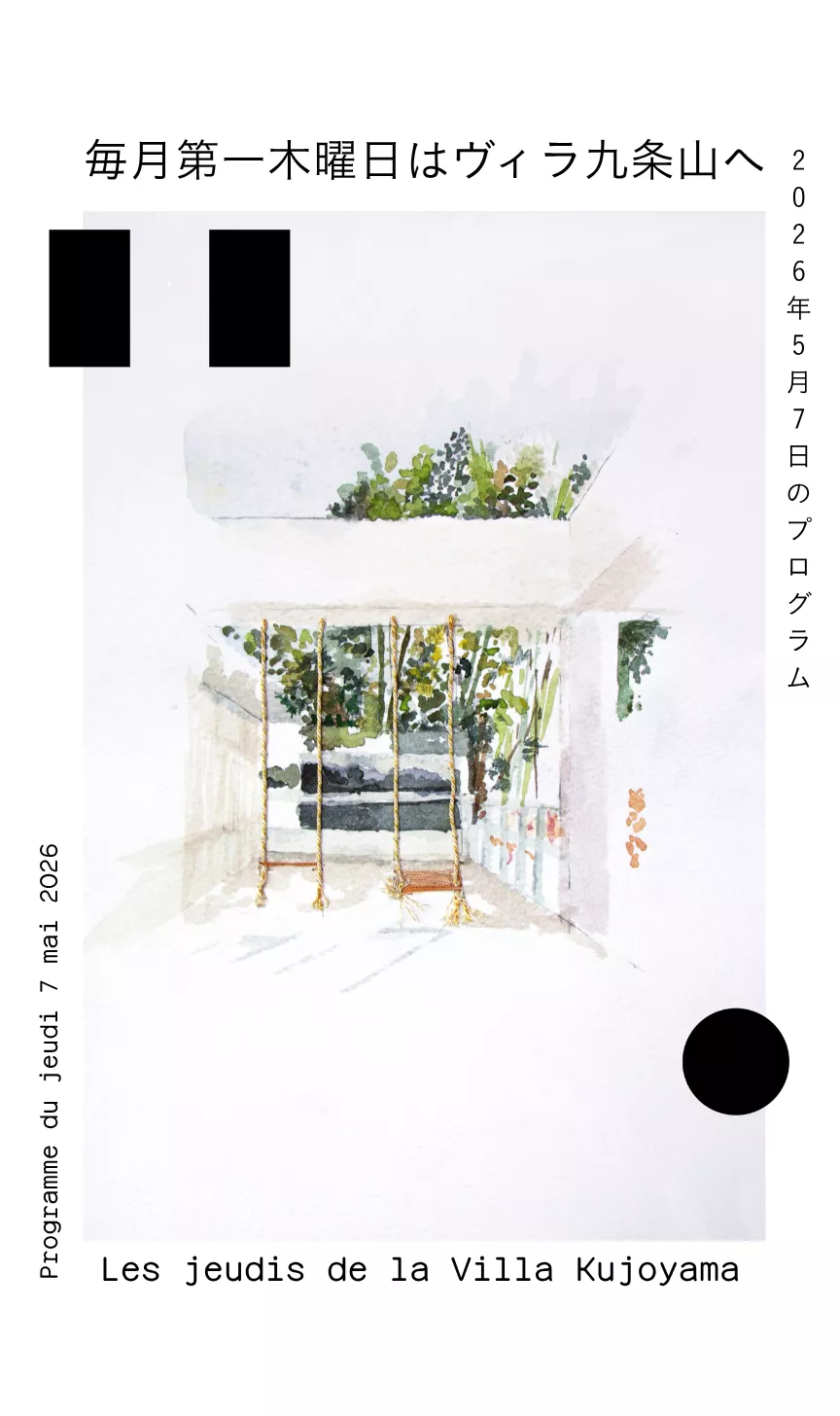
Visuel: Vue de la Villa #30 Mise en abyme
© Aurélie Lanoiselée (2026, métiers d’art)